Structure and optimize a Google Ads campaign for a premium K-beauty house
Result: a complete method drawn from a real campaign: a workable brief, three campaigns separated by intent, keywords that exclude as much as they target, and a traffic cost cut by about a quarter after tightening the queries.
This case is the figures side of a real campaign. For the method alone, with fill-in prompts and no figures: Structure a first Google Ads campaign
A real, anonymized case
This guide is based on a Google Ads Search campaign actually run with BAM for a client.
To protect the client's confidentiality, the brand name, the city, the protocols, the competitors and the exact keywords have been replaced: every example is reframed around a premium K-beauty house in London.
The impression, click, spend and cost-per-click figures have also been slightly modified: the orders of magnitude, the gaps between campaigns and the progression of the traffic cost are faithful to the real campaign, but no published figure is the exact account figure.
This case does not measure a cost per conversion: booking tracking was not consistent enough to attribute one reliably. The analysis therefore covers what was measurable: structure, query quality, CTR, CPC and the decline in traffic cost.
What you will learn
- launch the campaign with a single line, and let the proposals come;
- choose an audience and a campaign goal among the agent's proposals;
- receive the structure, the messaging angles and their risks, then ask for alternatives;
- generate premium keywords, informed by live competitive intelligence;
- go all the way to import-ready deliverables: keywords, ads, negatives, launch checklist;
- analyze results without confusing traffic with business performance;
- optimize queries to improve CTR and reduce CPC.
BAM's Google Ads Expert, in the Create space, does not replace your marketing decision. It builds on your brand strategy, proposes a campaign plan, then helps you validate priorities before activation. It is the direct application of the BAM axis "strategy before content": you do not produce a keyword list before clarifying the offer, the price positioning and the expected action.
One line is enough: the agent knows what to propose
A Google Ads campaign does not start with keywords. It starts with a clear business goal. In BAM, open the Create space, then the Google Ads Expert: it already knows your brand strategy. Your first message does not need to be a full brief, it points at the need; the agent behaves as a consultant without being asked. It proposes, you decide.
In the K-beauty case, the campaign started with a one-line message, typed as is, imperfections included:
"which keywords should we buy, consistent with Mayfair"
That is all. No need to describe the company, nor to ask the agent to act as a consultant: it already has the project's strategy, market study and personas, and consultant behavior is its default. From that single line, it proposed on its own the account structure, the messaging angles with their risks, the audiences and the deliverables.
« Which keywords should I buy for [your offer], consistent with [your anchor: address, neighborhood, price positioning]? »The rest of the context comes along the conversation, when the agent needs it:
- the real price points of your protocols or services;
- the existing landing pages;
- the real conversion path: booking, message, call (no online prepayment);
- the languages you actually serve;
- the available budget;
- the brand's style prohibitions.
The target, however, is never yours to supply: the agent proposes the audiences from your strategy, and you choose among its proposals.
Why one line is enough
Because the brief is not the source of the context: your BAM project is. Your message only points at the need of the moment; the strategy, the market and the price positioning are already there. In the K-beauty case: protocols between £260 and £520 (and a private experience on request), a prestige neighborhood as proof of anchoring, a budget of £1,500 per month, no medical, clinical, anxiety-inducing or promotional phrasing. And one guardrail decided in conversation: part of the international clientele speaks a language the house does not serve; it is not targeted until the service exists.
You are ready when your message points at a real need, even in one line: the context already lives in your project.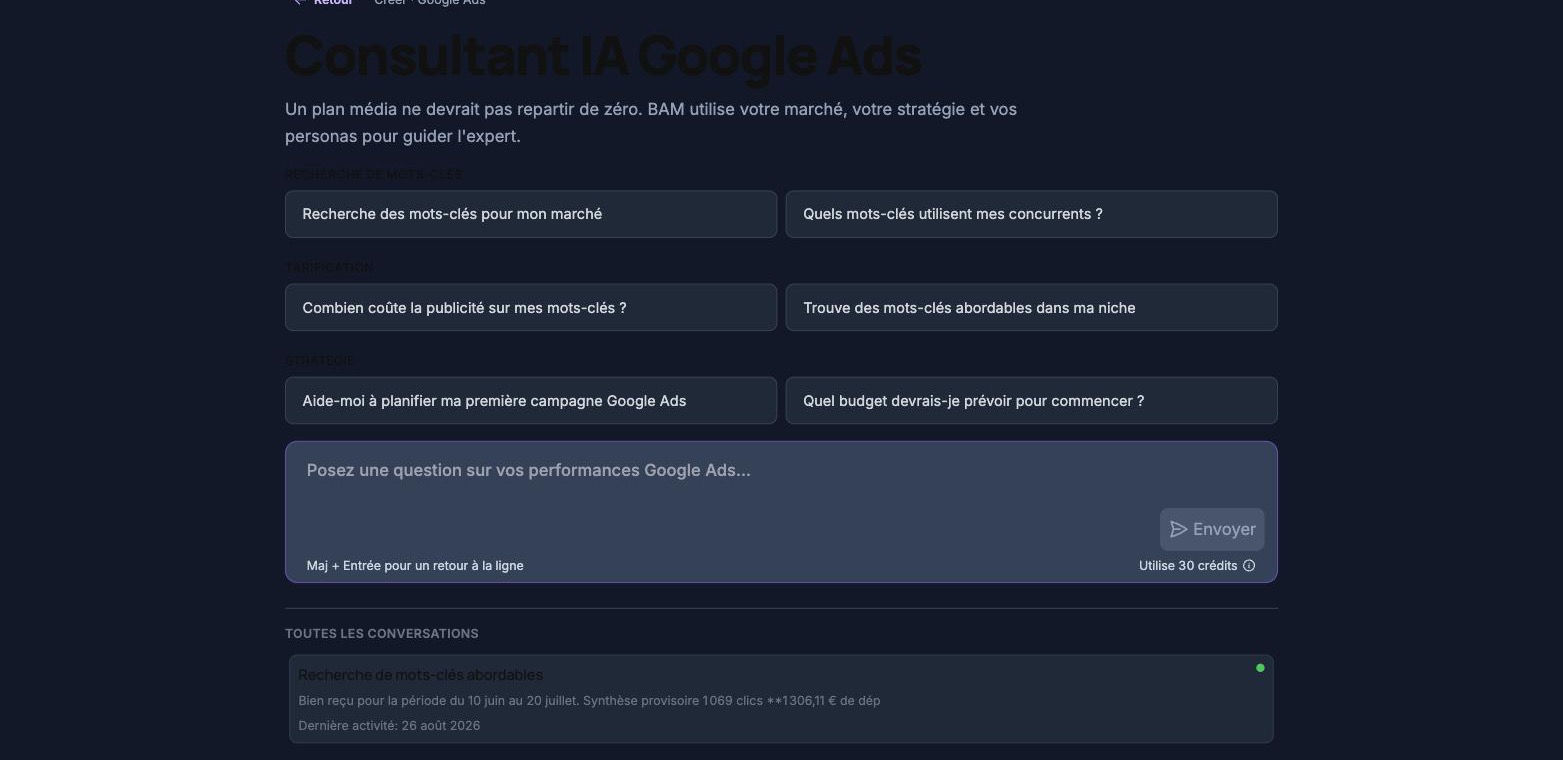
In your BAM project: the Create space, with the Google Ads entry. 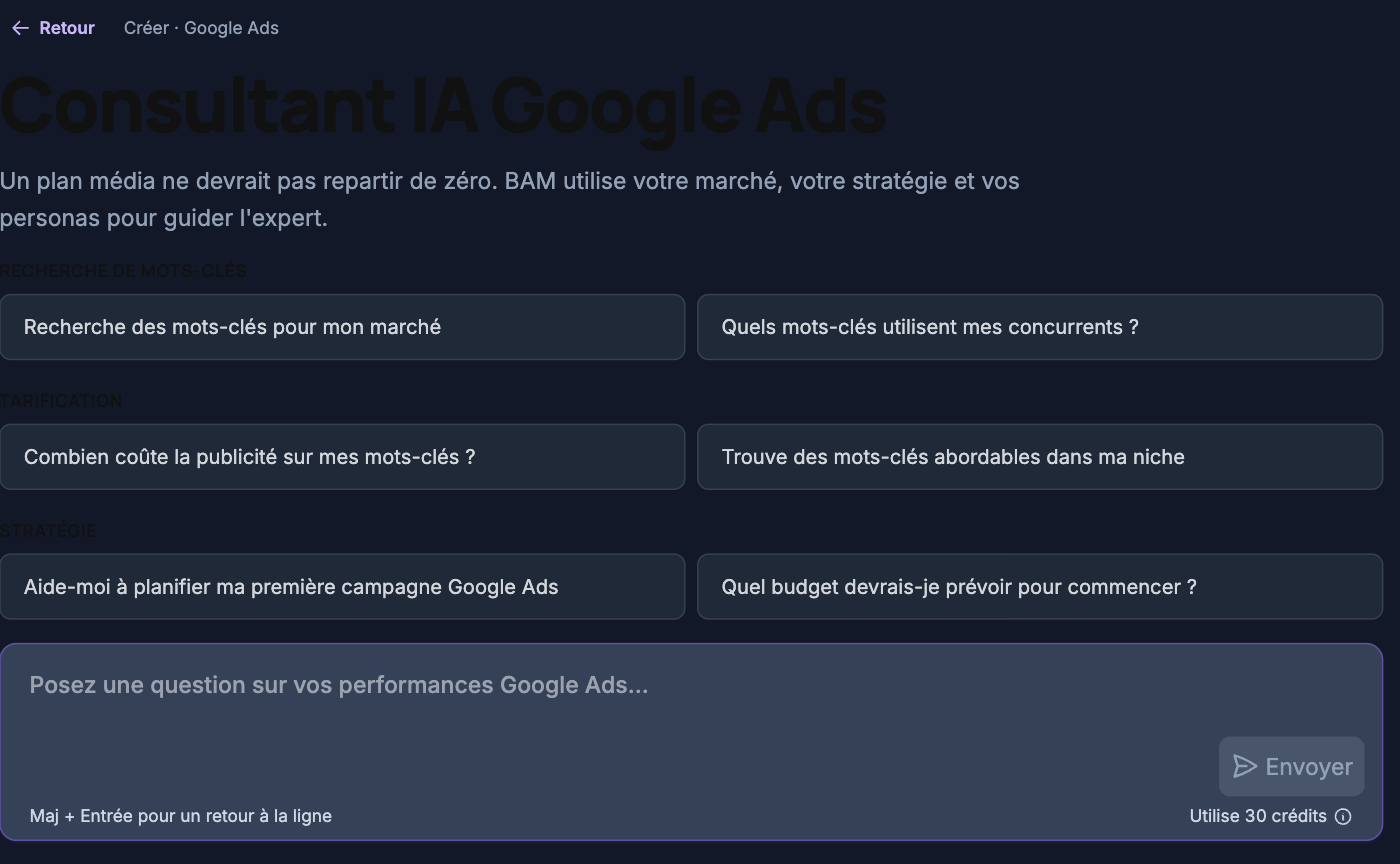
The Google Ads Expert opens on your keyword, pricing and strategy questions. The structure: proposed by the agent, decided by you
The three-campaign structure was not requested: the agent proposed it, with its reasons. Yours to validate, amend, or challenge with alternatives.
What the agent proposed on its own
- three campaigns (Brand, one generic per language) for clean control of budget and intent;
- the split by language, to really steer the budget of each market;
- anchoring the ads on the address and the neighborhood: capturing "I am nearby, I book now", and proving the premium footing;
- tying each persona to a precise protocol and price point, to defend the price;
- two messaging angles with their risks: "house and protocols", retained, versus "science and clinic", set aside (medical boundary, possible frictions);
- a deliberately cautious budget when costs per click are uncertain, to avoid underfeeding the most contested market.
Campaign Intent What you are trying to capture Brand Existing awareness People who already know the house or its K-beauty universe Generic EN English-language acquisition Locals and visitors searching in English for a premium K-beauty treatment in London Generic FR French-language acquisition French-speaking clients, based in London or visiting, looking for high-end K-beauty expertise Persona (anonymized) Associated protocol Price point The international visitor Signature protocol £520 The premium local Longevity protocol £370 to £440 The glow client Glow protocol £260 to £330 The very high-end clientele Private experience On request This separation then lets you compare comparable things. You must not analyze together:
- someone searching directly for your brand;
- a visitor looking for a K-beauty treatment in London;
- someone comparing low-cost salons;
- someone looking for a K-beauty product to buy online.
To push the agent further, one follow-up is enough:
« Give me the recommended plan and two alternatives for [your campaign]: one more aggressive, one more conservative, with the risks of each. Then tell me what you would do first over the first thirty days. »You are ready when you have decided between the proposals, not just approved the first one.Generate the keywords by intent
Do not ask for a huge keyword list. Ask for a structured list, with an identifiable intent and exclusion rules.
Before locking the keywords, the agent looked live at where the most frontal competitors of the market study are fighting: one owns the generic "facial + city", the other pushes the science-and-clinic register. Without knowing their exact spend, you know where they fight, hence where to differentiate: on the "house and protocols" territory, never on theirs.
« Generate a Google Ads keyword list for my generic campaigns. Important constraint: every keyword must explicitly include [your brand territory]. I want exact and phrase match keywords, a split by ad group, a column with the search intent, a column with the priority level, a negative keyword list and no phrasing that is [what your brand refuses]. »Here are the territories obtained in the K-beauty case (illustrative examples; in quotes: phrase match, in square brackets: exact match, Google Ads syntax).
Generic EN, ad group Keyword examples K-beauty facial London “k beauty facial london”, [k beauty facial london], “korean beauty facial london” Luxury K-beauty London “luxury k beauty london”, [luxury k beauty facial london], “premium korean beauty london” Korean skincare treatment “korean skincare treatment london”, [korean skincare treatment london], “k beauty skincare experience london” K-beauty central London “k beauty facial central london”, “korean beauty treatment central london” K-beauty experience “luxury k beauty experience london”, “premium korean facial london” Generic FR, ad group Keyword examples Soin visage K-beauty “soin visage k beauty londres”, [soin visage k beauty londres], “soin korean beauty londres” K-beauty premium “k beauty premium londres”, “soin k beauty haut de gamme londres”, [k beauty luxe londres] Expertise K-beauty “expert k beauty londres”, “protocole k beauty londres”, “soin coréen personnalisé londres” K-beauty Londres centre “soin k beauty londres centre”, “k beauty mayfair”, “institut k beauty luxe londres” Expérience K-beauty “expérience k beauty londres”, “rituel k beauty premium londres” Negatives, as important as the keywords
Negative keywords filter out searches incompatible with the positioning or the booking goal: low-cost products, training courses, jobs, tutorials, free-or-promo queries.
« Propose a negative keyword list for my campaign. Exclude: low-cost product searches, training courses, jobs, tutorials, [the uses incompatible with your offer], free-or-promo searches, and competitor-related searches, unless a conquest campaign is explicitly decided. Split the negatives by language and briefly explain the risk each category avoids. »You are ready when every keyword carries an identifiable intent and the exclusion list is written.Ask for the ads, without losing the positioning
The ads must translate the keyword's intent, without tipping the brand into a clinical or promotional promise.
« Write two Responsive Search Ads per ad group. Headlines of 30 characters maximum, descriptions of 90 characters maximum, [your languages] kept separate. Tone: [your brand register]. Highlight [your proofs, your city and your booking mode]. Never use [the terms your brand refuses]. For each ad, add the targeted intent, the main message and the recommended landing page. »The agent must keep the keyword, the ad and the page consistent. In the K-beauty case:
Search Ad promise Landing page “luxury k beauty facial london” Premium K-beauty protocol by appointment House and booking page “soin visage k beauty londres” Personalized K-beauty facial in London Adapted protocol page Brand search K-beauty house, booking and practical information The establishment's home page All the way to import-ready deliverables
The agent does not stop at ideas: it produces the import files and the setup checklist. In the K-beauty case, the ad groups still on the science-and-clinic register were removed from the file before import, to match the retained angle.
« Give me the import-ready deliverables for [your campaign]: a keywords file, an ads file and a negatives file, plus a setup checklist: extensions, location, calls, tracking. »You are ready when every ad respects the brand prohibitions and promises exactly what the page delivers.Import, measure, then have it analyzed
After a broadcast period, do not ask the agent: "Is the campaign working?". Give it the observed data and ask for a structured reading.
« Here are the results of my Google Ads Search campaigns over [period]: [paste your impressions, clicks, spend, CPC and CTR, global then per campaign]. Conversion tracking is not reliable yet: use no cost per conversion and do not present these results as revenue. Analyze: the lessons per campaign, the CPC and CTR gaps, the hypotheses on traffic quality, the priority optimizations and the missing data before profitability can be judged. »The instruction about cost per conversion is essential: as long as booking tracking is not consistent, a "cost per conversion" would be fiction. In the K-beauty case, eight weeks of delivery provided the material for the next step's table.
You are ready when your analysis request separates what is measured from what is not yet.The proof: the traffic cost went down
In this case, the lesson is not "the campaign generated a cost per conversion of X". That would be imprecise. The lesson is that moving from broad targeting to a precise structure improves traffic quality and reduces the cost of clicks on the retained queries.
Indicator Observed result Impressions 104,809 Clicks 3,485 Spend £2,224.05 Final average CPC £0.64 CPC observed during the broader phase About £0.87 Generic EN CTR 5.61% Generic FR CTR 2.69% Brand CPC £0.41 The average CPC decreased between the development phase of the generic campaigns and the end of the period, going from about £0.87 to £0.64: roughly a quarter less per click. This drop does not prove, on its own, a revenue increase. It shows that the structuring, exclusion and tightening work made it possible to buy traffic at a more controlled cost.
You are ready when you can state what your figures prove, and above all what they do not prove yet.After separating the intents, analyzing the searches and progressively excluding the queries least consistent with the offer, the average traffic cost dropped by about a quarter.
The campaign has not yet allowed a reliable cost per booking. The next priority is therefore to tie clicks, calls, messages and bookings to consistent conversion tracking.
Make the Google Ads Expert your optimization copilot
The value of the agent is not only producing a first structure. It is keeping the campaign context to help you decide at every step. The full sequence:
- state the campaign goal: the expected business action;
- choose the audience among the agent's proposals: brand searches, English-speaking clients, French-speaking clients;
- structure the campaigns: Brand plus one generic per language;
- generate the keywords by intent, all tied to the brand territory;
- create consistent ads, without forbidden vocabulary;
- import and launch, keeping the campaigns separate;
- analyze the observable results: CTR, CPC, search terms, spend distribution;
- exclude and tighten: remove queries that attract volume but not the right intent;
- make tracking reliable: confirmed booking, qualified call, message, purchase;
- decide what comes next: increase, reduce, pause or create a separate campaign.
This method serves the BAM axes "from fuzzy brief to a validatable campaign" and "humans keep the hand": the agent proposes the structure and speeds up the analysis; you choose the audience among its proposals, validate the keywords and decide which lessons guide what comes next.
You are ready when every new campaign decision starts from the kept context, not from a blank page.Final checkpoint: verify before launching
- The business goal is set before the first keyword.
- The audiences were chosen among the agent's proposals, not decreed.
- The agent proposed angles and alternatives with their risks, not a single path.
- Each campaign isolates a comparable intent (brand, language, generic).
- Each ad group carries an identifiable intent and its exclusions.
- The ads respect the brand prohibitions, word for word.
- The analysis separates traffic cost from business performance.
- The next tracking priority is written down in black and white.
Only tick what is true. In doubt? Go back to the relevant step.
Buy the right intent, not volume
You no longer launch a campaign hoping it "works": you set a goal, choose your audiences among the agent's proposals, isolate the intents and tighten the queries until the traffic cost reflects your strategy. In the K-beauty case, that work cut the cost per click by about a quarter in eight weeks, even before conversions could be measured.
Skill unlocked: steering a Google Ads campaign by intent, from the brief to the traffic cost.
Create my marketing system